
The Universe Is Finite
THE FIRST REASON WHY THE UNIVERSE IS NOT INFINITE
In the first chapter of Big Issues We Face Today (Part 1 of “Does God Exist or Are We Just Making This Up?”), we presented a scientific reason why the Universe is not infinite: the Big Bang Cosmology, which is scientifically verifiable.
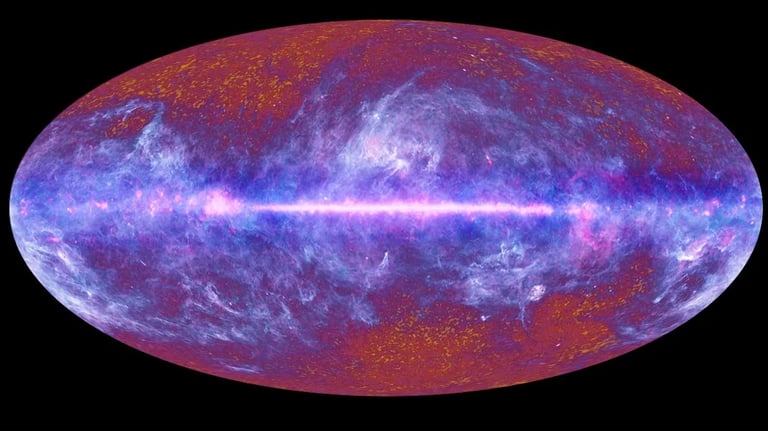
The Universe had a beginning. Scientists are getting more and more data to support this. We explored the Big Bang Cosmology and the scientific evidence of a massive explosion that points to the origin of the Universe. Can the Universe be infinite if it had a beginning?
This all-sky image of the cosmic microwave background, created from data collected by the European Space Agency's Planck satellite's first all-sky survey, shows echoes of the Big Bang left over from the dawn of the universe. (Image credit: ESA/ LFI & HFI Consortia)
THE SECOND REASON WHY THE UNIVERSE IS NOT INFINITE
A second reason we know that the Universe is not infinite is the Second Law of Thermodynamics, or what is called the heat-loss theory. The First Law of Thermodynamics tells us that there is no new energy coming into the Universe, so we know that the Universe is not being refurbished. While the First Law of Thermodynamics tells us that while energy is neither created nor destroyed, it can be changed from one form to another.
The Second Law of Thermodynamics tells us that when energy changes from one form to another entropy (disorder) always increases, so the Universe has a limited supply of usable energy. Entropy is the dispersion of energy being used.[1] It is a measure of the molecular disorder, or randomness, of a system. Eventually, entropy increases to a point that heat energy is no longer useful for doing any work.
The Second Law of Thermodynamics is that over time energy begins to grow cold and cannot do any more work. It’s like a cup of coffee. When you put it down on a table it’s hot, but when you leave it, it grows colder because the energy molecules begin to disperse. As molecules start to move away from each other, the coffee begins to cool down.
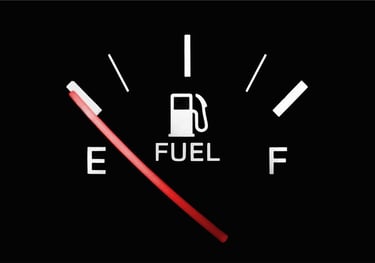
Eventually every molecular part of the Universe (all its structures, and everything in it, including us), is moving apart and, thus, cooling off. There may be the creation of new stars but gradually everything in the Universe is losing energy. One cannot contend that the Universe is infinite if it only has a limited amount of energy to lose, and it is losing it. It’s like putting 10 gallons of gas in your car and trying to drive forever. You will eventually run out of gas.
The Universe is running out of gas; that is, it is running out of usable energy. The energy is still in the Universe in another form, but it becomes unusable. Because of this, the Universe will reach what scientists call “heat death.” That means the Universe will die. Therefore, the Universe cannot be infinite.
If the Universe was infinite, and the Second Law of Thermodynamics true, it would have run out of energy a long time ago. You cannot say the Universe has a limited amount of usable energy but that it is infinite. These are not inconsistent assertions. The empirical data tells us that the Universe is gradually dying and will eventually die, and if it is dying and will die, then it is not infinite.
In review, we have covered two reasons why the Universe is not infinite. The first is Big Bang Cosmology—the Universe had a beginning. The second is the Second Law of Thermodynamics—the Universe is running out of usable energy. If the Universe had a beginning plus is moving toward heat death, then it hasn’t always existed. Once again, based on science, we have presented two reasons for why the Universe is not infinite: It had a beginning, and it is losing usable energy.
The Second Law of Thermodynamics tells that there is a limited amount of usable energy in the Universe. That usable energy it is being used up, resulting in heat loss and eventual heat death. The Universe cannot be infinite, lasting from forever and to forever, if it is losing usable energy.” It cannot be infinite if it had both a beginning (Big Bang) and will eventually have an end (Entropy).”
In the last chapter, we looked at several alternative theories for the origin the Universe, including the Oscillating Universe Theory (that the Big Bang repeats itself, as the Universe expands and collapses eternally). The problem with this theory is that our Universe has already reached an escape velocity. As it continues to expand, it lacks enough mass at its core to pull back down on itself and start another (and then eternal) repetition of Big Bangs.
Not only that, but if every time the Universe expanded and collapsed, according to the Second Law of Thermodynamics, it would lose energy. Something losing energy could not be sustained forever unless there is new energy coming into the system. Yet, the First Law of Thermodynamics tells us we have no new energy coming into this system. Therefore, the Oscillating Universe Theory is false.
Another theory we considered is the Steady State Theory, that the Universe has always existed in some form. This has the same problems (Big Bang Cosmology and 2nd Law of Thermodynamics) and is therefore also false. If the Universe began with an explosion and is moving toward heat death, then it hasn’t always existed.
This leads us to a third reason why the Universe is not infinite—Logical Absurdity.
A THIRD REASON WHY THE UNIVERSE IS NOT INFINITE — LOGICAL ABSURDITY[2]
The Universe, all matter and energy, everything in existence as we know it, cannot be infinite because of the logical absurdity of what we call an “Infinite Causal Regress” (ICR). An ICR is an infinite chain of cause and effect (something caused something that caused something, that caused something, infinitely). Infinite sets do not exist, and like square circles, are logically contradictory.
Some might say that our Universe had a Big Bang beginning, but before that another Universe existed, giving rise to our Universe, and maybe before that another one, and on and on, infinitely. As if there was a Universe-machine spitting out Universes to infinity. When someone proposes such a hypothesis, they are setting up something that is logically impossible, positing that something created something, that was itself created by something, and on and on. We call this “the impossibility of an Infinite Causal Regress.”
For example if I got to this place where I am right now by taking a series of steps that are called “antecedent moments” (previous steps). I am at this place at this moment, but a moment ago I was in another place, and a moment before that I was at yet another place. Every one of those moments was connected in what we would call a causal chain.
In a causal chain, there is an order or sequence in this series of steps. I didn’t get to this moment before those other moments occurred. We measure such changes of juxtaposition by what we call time. Time is a way of measuring change. Change in our time and space continuum happens linearly as one thing precedes another. There can be multiple things happening simultaneously, but time happens sequentially, like links in a chain. Each step or link is a moment in time.
If this cause-and-effect chain is infinite, it is an Infinite Causal Regress. In such an infinite chain, where are the starting and ending points? In an Infinite Causal Regress, there is no starting point because it’s infinite. We think of infinity as a really, really, really, long time; however, it has nothing to do with time. It is outside time. It is “in(not)-finite.”
I cannot arrive at this present point in time if the chain of change is infinite, because to return to the beginning I cannot know how far back to go? I must go back infinitely. Logically that tells me there is no beginning because it is infinite. I have no starting point.
So, if everything is in an infinite chain of cause-and-effect (an ICR), I have no place to begin to move and get to this present point in space and time. I can only get to this point in time and space if I have a finite starting place. But if the chain of cause and effect is infinite, there is no starting point. Therefore, I cannot arrive at this place because there is no place to start.
If I were to walk across an infinite desert, how long would it take? I would never get to the other side because it is infinite. Not only that, if it is infinite, there would be no beginning. I can’t get anywhere. Infinite things and finite things in time and space are completely different. Our minds only know finite things, things with beginnings and endings, with starts and stops, that are in chain-like measurable sequences.
An actual infinite physical thing in time and space existence doesn’t exist. This is a hard concept for us to comprehend because we always think of everything in time and space sequences, with beginnings and endings. There is no such thing as an actual infinite physical thing (including the finite Universe). Things that can be counted and measured are not infinite. You might think a physical something is potentially infinite, but you will never get there.
If I set up a whole row of cones and I whack one and it topples over and hits the next cone, and that one hits the next, each is a cause of the one that follows, and so on. But notice I must start it. It’s like a billiard table. I must start the motion of the billiard balls. There must be a beginning event. If there is no beginning event, nothing moves! If something is infinite then there is no beginning event, certainly not in time and space, because there is no place for it to begin.


For example, asking for an infinite library of books is a logical absurdity, because library books are countable. So, if you bring me three books, there is still an infinite number of books. How is that? According to “infinite set theory,” you can postulate an infinite set of imaginary numbers, but you can’t have an actual infinite set of numbers.
As soon as things become physical, they are finite, and we can count them. If it is infinite, you can’t add or subtract from it. It’s logically absurd to add to or subtract from infinite. It’s like going to a hotel with an infinite number or rooms and you rent rooms for six people. How many rooms do you have left to rent? You still have an infinite number.
Let’s suppose I am in an infinitely deep pit. Will I ever have a chance of jumping out? No. The pit has no bottom so there’s no bottom for me to jump from—and there is no top for me to jump to. Infinite things and finite things don’t correspond. An actual infinite thing cannot exist in time and space because, by definition, time and space are finite.
If I say go get me an infinite set of chairs, how many chairs do you have to get? You can’t get an infinite set of chairs because every time you get a pile of chairs you think is infinite, someone gets another chair. How many chairs do you need to add to have an infinite number? Infinite is not countable.
How can you have an infinite number if you can add or subtract one from it? You can’t have an infinite set of anything in time, space, energy, or matter—even quarks, because they are finite and you can still count them, so you end up with this absurdity called an Infinite Casual Regress.
When you try to apply the infinite set theory of mathematics to actual objects, it doesn’t work. The reason it doesn’t work is because in our time and space existence, there is no such thing as an infinite causal regress (ICR). There is no such thing as an infinite in finite time and space.
This is a very difficult thing to try to wiggle out of, and yet it’s actually very simple. There can’t possibly be anything infinite about the finite. Finite things mean they have limits, while an infinite thing doesn’t have any limits. So, the finite cannot be infinite.
The Universe is in time and space, possesses matter and energy, and is in a cause-and-effect relationship. Therefore, the Universe is not infinite. Things in cause-and-effect relationship can’t be infinite because it sets up a logical impossibility of an infinite causal regress. You can’t go back in time infinitely. That is an impossibility of terms. You can’t be in time and say it’s infinite. Infinite is in no-time. It is beyond time. Finite is what we experience in our Universe.
CONCLUDING THOUGHTS
The first premise we examined is that the Universe is not infinite and is therefore finite. The first two reasons we gave for this premise are scientific: the Big Bang Cosmology (the Universe had a beginning) and the Second Law of Thermodynamics (the Universe has a limited amount of usable energy, so heat death ultimately occurs).
The third reason we gave for the conclusion that the Universe is not infinite but finite, is the logical absurdity of an infinite series of finite causes. It is logically impossible to say that the Universe is both infinite and finite. Likewise, it is a logical absurdity to say we exist infinitely yet have antecedent moments.
In Chapter Three we will go present two more premises (premises #s 2 and 3) related to the Cosmological discussion for the existence of God. The second premise is that the Universe was caused. Our Universe wasn’t there and then it came into existence—as our Big Bang Cosmology tells us. It didn’t exist at some point in the past—and now it does. We will see that it is reasonable to say it had a cause, because all things that began to exist were caused to exist.
In Chapter Three we will also put forth a third premise that it is reasonable to believe that there is an Uncaused Cause or what we call AN INFINITE STATE OF AFFAIRS is the cause of the Universe.
In Chapter Four We will pose five questions related to our Cosmological argument of for the existence of the Universe, and then, in Chapters Five through Seven, we will see that this Uncaused Cause has certain attributes—and that these attributes match what the Biblical writers call “God.”
[1] Entropy is the measure of a system's thermal energy per unit temperature that is unavailable for doing useful work “Second Law of Thermodynamics and entropy,” https://www.khanacademy.org/science/ap-biology/cellular-energetics/cellular-energy/v/second-law-of-thermodynamics-and-entropy.
[2] Much of this material is from Kit Lauer’s Apologetic course taught at Hope Chapel, Kihei, Hawaii. See also, “The Existence of God and the Beginning of the Universe” by William Lane Craig.