
The Universe Was Caused … by an Infinite State of Affairs
As soon as things become physical, they are finite, and we can measure and count them. You can’t add or subtract from infinite, so it is logically absurd to add or subtract from something infinite. There is no such thing as an infinite in time and space. Finite things mean they have limits; infinite things do not.
The Universe is in finite time and space, possesses finite matter and energy, and is in a cause-and-effect relationship; therefore, the Universe is not infinite. Things in a cause-and-effect relationship can’t be infinite because it sets up a logical impossibility of an Infinite Causal Regress. You can’t go back in time infinitely. That is an impossibility of terms. You can’t be in time and say it’s infinite. Infinite is in no-time.
PREMISE #2 — THE UNIVERSE WAS CAUSED
Following the premise that the Universe is not infinite, our second premise is that the Universe was caused. It is surprising what people come up with philosophically to avoid the fact that the Universe was caused to exist. It is absurd to think that something finite began to exist (including the Universe) but wasn’t caused to exist.
The scientific data of a Big Bang Cosmology, pointing to a beginning, the Second Law of Thermodynamics, pointing to the loss of usable energy, moving the Universe toward heat death, plus the Logical Fallacy and impossibility of an Infinite Causal Regress, all push us to acknowledge the Universe is not infinite. If the Universe had a beginning and is not infinite, it is reasonable, therefore, to think it was caused.[3]
Some people think the Universe just popped into existence out of nothing, or that hydrogen atoms popped into existence out of nothing. Others argue that quantum fluctuations caused some kind of particles to appear. But what is a quantum fluctuation? Is it a fluctuation of nothing? How do you fluctuate nothing? Think about what nothing is—nothing! You can’t fluctuate nothing!
A quantum fluctuation is the fluctuation of something. If quantum fluctuations started the Universe, where did that quantum fluctuations come from, and what caused the fluctuation? The fluctuation argument is desperate and fails.
What about quarks and subatomic particles? Did they just pop out of nothing? We can’t predict the pattern of quarks, but just because we can’t predict their patterns doesn’t mean they weren’t caused. What caused the quarks? We just don’t know exactly what caused them, but we do know that all things with finite physical properties began to exist. We must stay within that reality.
Everything that begins to exist is caused to begin to exist!
We are arguing that everything that begins to exist is caused to begin to exist. If you pick up a water bottle and throw it across the room and it hits somebody, there was a cause. We can be sure that everything, even down to the smallest quantum particles that are part of our finite, measurable Universe, was caused to exist, and that everything that began to exist was caused. The question is, what caused it all to begin to exist?
Some believe that the String Theory (that everything in our Universe is made up of tiny vibrating strings) gives us the answer to the existence of the Universe—but where did the strings come from? Like the Steady State Theory, scientific data points to a beginning event (Big Bang) rather than an infinite and eternal Universe. Absurdly, people argue that the Universe (be it strings, hydrogen atoms, or whatever) has always existed—or equally absurd, that it just popped into existence out of nothing.
It is absurd to think that something began to exist without it being caused. We argue that everything that begins to exist is caused to begin to exist. The question is, when something begins to exist, what caused it to begin to exist? Our Universe wasn’t there and then it came into existence, as our Big Bang Cosmology tells us. It didn’t exist at some point in the past—and now it does—so we conclude that the Universe has a cause, because all things that began to exist were caused to exist.
PREMISE #3 —AN “INFINITE STATE OF AFFAIRS” CAUSED THE UNIVERSE
In this chapter, we have seen that the only possibility for the Universe to have begun to exist is that it was caused to exist. Why does the Universe need a cause? Because it began to exist! Things that begin to exist need causes for their beginnings. So, what happened? How did the Universe get here? How did it come into existence without setting up an Infinite Causal Regress (ICR), or that it somehow popped into existence out of nothing?
Our third premise is that the Universe was caused to exist by an “INFINITE STATE OF AFFAIRS,” something that has always existed and is itself uncaused. The only logical possibility is that an UNCAUSED CAUSE began the Universe. This makes sense logically. If something is uncaused, it has always existed, and if it has always existed, then it is infinite.
We resolve the dilemmas of an Infinite Causal Regress or that “everything popped out of nothing” by logically positing that there is another category other than finite—that category is an infinite, UNCAUSED CAUSE–an INFINITE STATE OF AFFAIRS. Notice that we are not starting with God, but with an UNCAUSED CAUSE that is not finite. What category is there other than finite? The only other category is Infinite, an INFINITE STATE OF AFFAIRS, something that is not finite, but in(not)-finite. The Bible refers to this as God.
WHAT CAUSED THIS INFINITE STATE OF AFFAIRS (GOD)?
So, what caused this INFINITE STATE OF AFFAIRS (God)? Someone might ask, “If everything needs a cause, what caused God?” Notice that we have not said, everything needs a cause. We have said that everything that began to exist needs a cause.
…we have not said, everything needs a cause—we have said that everything that began to exist needs a cause.
There is a category for things that are not caused: an INFINITE STATE OF AFFAIRS, or God. God was not caused to exist, so he doesn’t need an explanation to the cause of his existence. There is nothing illogical about a category that never began to exist. There is nothing illogical about positing that INFINITE STATE OF AFFAIRS (God) began the Universe. He Himself never began to exist because He is uncaused.
It is not only logical that this INFINITE STATE OF AFFAIRS (God) does exist, but that it (He) must exist to make sense out of everything else. Why? Because if we don’t posit that an uncaused cause exists, we are left trying to figure out what caused the FIRST CAUSE of the Universe, and then what caused the cause of that cause, then on to the next cause, and the next cause, and the next cause, and on and on. We are stuck in an Infinite Causal Regress (ICR!
CONCLUDING THOUGHTS
The first premise that we explored in the first two chapters was that the Universe is not infinite but had a beginning and will have an ending. The scientific data of a Big Bang Cosmology (pointing to the Universe having a beginning) and the Second Law of Thermodynamics, (pointing to the loss of usable energy moving the Universe toward heat death), plus the logical argument of the impossibility of an Infinite Causal Regress (ICR), all push us to acknowledge that the Universe is finite.
There was a beginning event that was the cause of the Universe. (That doesn’t mean “God” was responsible for it—we have not arrived at that fact yet.) Our conclusion that the Universe was caused to exist by an INFINITE STATE OF AFFAIRS is based upon both scientific evidence and sound reasoning. Because the Universe had a beginning, it is finite, and because it is finite, it is a logical impossibility to say that is infinite. Since all things that began to exist are caused to exist, and the Universe began to exist, we conclude that it was caused to exist.
To explain the how the finite stuff of the Universe was caused to exist, we must posit an infinite thing to start it. Thus, our third premise is that the cause of the Universe is an INFINITE STATE OF AFFAIRS. We posit that the FIRST CAUSE of the Universe was an infinite, uncaused cause. This uncaused cause wasn’t caused and it began everything that was caused. This infinite, uncaused cause exists as an INFINITE STATE OF AFFAIRS, which the Bible calls, God.
In Chapter Four we will pose five questions that are likely to be met by the answer, similar to the Geico add, “Everybody knows that!” The responses following “Everybody know that”, however, may be surprising. We will somewhat playfully try to capture what we have covered thus far, including the logical premise that an INFINITE STATE OF AFFAIRS caused the Universe to exist.
This will lead to Part 2 of Big Issues We Face Today, which is “If God Exists, What Is He Like? We will discover the answer by examining and drawing from the properties of an INFINITE STATE OF AFFAIRS.
[1] “Ask Ethan, “How Far Is The Edge Of The Universe From The Farthest Galaxy?” https://www.forbes.com/sites/startswithabang/2017/05/06/ask-ethan-how-far-is-the-edge-of-the-Universe-from-the-farthest-galaxy/#5115d5d55042.
[2] Ibid.
[3] Some believe the String Theory explains the existence of the Universe. However, renowned theoretical physicist Lee Smolin in, The Trouble with Physics, the Fall of Science, and What Comes Next, (New York: Penguin Books, 2006) criticizes the string theory and its prominence in contemporary theoretical physics, and believes that fundamental physics (the search for the laws of nature) is losing its way, in its hypothesizing about extra dimensions, exotic particles, multiple Universes, and strings. These are speculations with no possibility of being tested.
BACKTRACKING TO PREMISE #1: THE UNIVERSE IS NOT INFINITE
In Chapter One and Part 1 of “Does God Exist or Are We Just Making This Up?” we covered the first scientific reason of why the Universe cannot be infinite: the Big Bang Cosmology. Scientific evidence points to a massive explosion as the origin of the Universe.
In Chapter Two, we looked at a second scientific reason for concluding the Universe is finite and not infinite: the Second Law of Thermodynamics, indicating that the there is a diminishing amount of usable energy, a heat loss, which will eventually lead to the heat death of the Universe. Since the Universe has a beginning, then it cannot be infinite, lasting from forever. Since the Universe is winding down in terms of usable energy and is moving toward heat death; therefore, it will not last forever. Thus, the Steady State Theory, that the Universe has always existed in some form and will aways exist in some form is false.
A third reason why the Universe is not infinite, which we also examined in Chapter 2 (Part 2 of Does God Really Exist?) is the logical absurdity of an Infinite Causal Regress (ICR). As we saw, an ICR is an infinite chain of finite cause-and-effect events. The problem is that no matter how far back in time you go, anything that began to exist must have a cause, and this cause, which also began to exist must also have a cause, and on and on. To propose such is an ICR is a logical absurdity.
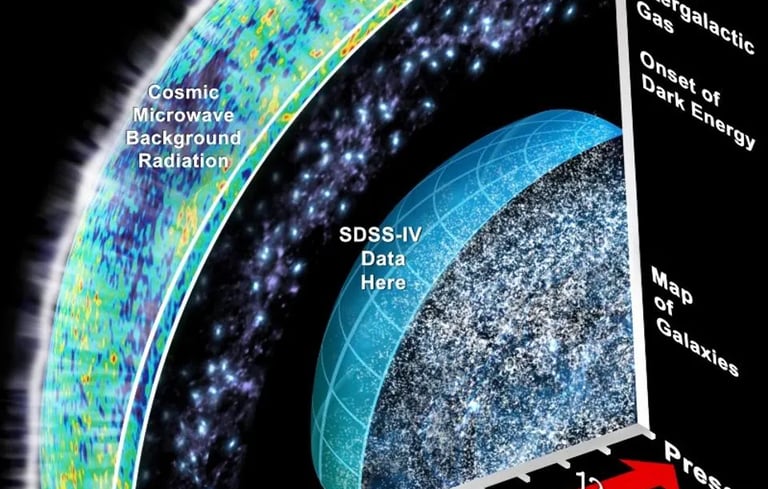
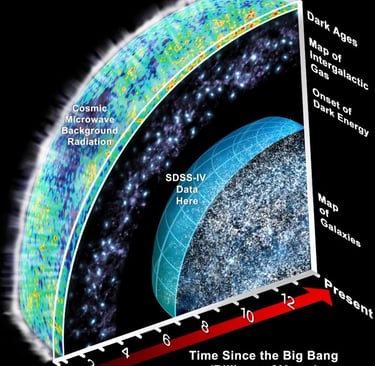
An actual infinite thing in time and space, where everything, including the sum of its parts, is measurable with beginnings and endings, is itself finite and not infinite. All physical things in the Universe can be counted and measured, they have beginnings and endings, so are not infinite. Astrophysicist Ethan Siegel sums this up as follows:[1]
“Seeing what we do in the Universe (and not more, and not less) is possible because of a combination of three things:
The fact that it's been a finite amount of time, 13.8 billion years, since the Big Bang,
The fact that the speed of light, the maximum speed that any signal or particle can travel in the Universe, is finite and constant,
And the fact that the fabric of space itself has been stretching and expanding ever since the Big Bang occurred.”
Image Credit: Dana Berry / SkyWorks Digital Inc. and the SDSS collaboration.
Next up: Five Questions to Ask