
The Universe is Not Infinite
THE COSMOS AND THE BIBLE
Why should we have this discussion about the Cosmos? Because, as we begin to observe the “invisible qualities” that we derive as we observe the Cosmos, we find that they match what God reveals about Himself in the Bible and are persuasive evidence for God’s existence.
When you talk with friends and family members who are somewhat skeptical or perhaps seeking, it is difficult for them to wrap their brains around what you tell them the Bible says about God. They think the Bible and science are at odds with one another. Many have picked up ideas from others that causes them to be skeptical. If we tell them we believe in God and that we have encountered Him, they think our experience is subjective, like someone who claimed they were abducted by aliens. How do they know that what we say is true and not just something we imagined?
This is not to discount the tremendous power of our story. Our testimony is a way of coming against the confusion and delusion all around us. We are not backing down from sharing our story of coming to know the God of the Bible in a personal way. But the cosmological discussion connects and lends credibility to our testimony of coming to know Jesus Christ. It also comports with the revelation of Scripture and can help those who are skeptical gain a clearer understanding of God.
Some think our belief in the authority of Scripture is based on circular reasoning and is therefore self-validating. We can counter that misperception, to some degree, by pointing to the fulfillment of Biblical prophecy and discoveries of archaeology—but our doubting friend doesn’t have time to explore all of that—or they may have read all kinds of things that seem to undermine what we believe. The cosmological discussion will, however, not only increase our faith and understanding, but also enable us to lend credibility to what we hold about God and the revelation of Scripture in discussions with skeptics.
We can give a logical explanation for God’s existence by reasoning from what we know about the Cosmos. We can give the reason for why the existence of Universe calls for an “uncaused-cause”—"an infinite state of affairs.” Then we will match the properties of this “infinite state of affairs” with the properties of God revealed in the Bible. That’s the beauty of this discussion.
We will begin by looking at reasons for the premise that the Universe is not infinite. In the next chapter we consider a scientific reason that the Universe is not infinite. Then, in the chapter after that we will unpack a second scientific reason as well as a logical reason for this premise that the Universe is finite. In chapters three and four, we will examine two more premises: “the Universe was caused,” and “the Universe was caused by an Infinite State of Affairs.”
THE ANTHROPHIC PRINCIPLE
When we study things that are highly complex, we notice design. When we look at life in and around us, there appears to be intelligent design, not randomness. Life is too organized and information-rich, right down to our DNA to be chance. When we look outward, we see a fine-tuning of the Universe with chemical residuals, the organization of the planets, and other highly improbable factors necessary for our existence as human beings
This is what we call the anthropic principle. “Anthropic” describes the unique relationship between the human observer and the natural world. The “anthropic principle” is that the natural world is intelligible to humans. It is uniquely fitted for the human capacity to observe nature and the Universe to try to make sense of it.
Our senses and brains are singularly equipped to interact with nature, and physical nature seems specially adapted to be discoverable by us humans. This suggests that nature must have been “tuned” to produce creatures that could perceive it. Since such “tuning” is found everywhere in nature it is a great indicator that the universe cannot be meaningless or accidental. This points to the conclusion that there is design that seems to have had us in view when it began.
Now if this is true, then there is the sense of teleology—which has to do with the design of something with a purpose in view. Design suggests intelligence—and intelligence is a personal attribute. Rocks and inanimate objects don’t have intelligence. If there is design, it is reasonable to conclude there is a powerful intelligent designer. Someone could argue, however, that it was just an intelligent alien species that designed us.
As compelling as the argument from design for the existence of God might be, however, we will focus instead on the beauty of the cosmological discussion. There is very little wiggle room to negate how certain attributes of God flow logically from cosmology. Amazingly, as we shall see, these attributes correlate with the revelation of God in Scripture.
THE COSMOLOGICAL REASON FOR GOD’S EXISTENCE
Kit Lauer did his PhD on the Intelligent Design argument for the existence of God. Nonetheless, he believed the Cosmological argument for God was more powerful than that of design. I (Linus) spent many hours studying Kit’s three-hour lecture seeking to digest and absorb personally the profundity of what he presented. Doing so impacted me greatly. I hope it will you as well.
As we look at the cosmological argument to answer the question “Does God Really Exist or Are We Just Making This Up?”, I am hopeful that certain things will come together, the light will go on, and you will conclude as I have I that God really does exist.”
When we speak of the cosmological argument for God’s existence, we are talking about the Cosmos, the study of the Universe and all that it comprises it (time, space, energy, and matter). We are especially concentrating on the origin of the Universe both scientifically and philosophically. As we do, we will learn more about God and His existence.
The Bible tells us that when we observe the Universe, we can actually come to know God. As we look at all there is in the Universe; as we look at ourselves, our hands, our bodies, and our brains; as we look at plants and creatures around us; as we look at quarks and subatomic particles; as we look beyond us to the planets and stars; as we look at far away galaxies; and as we gather information outwardly and inwardly, we discover God’s attributes in a deep and profound way.
In Romans 1:20, the apostle Paul points out that the “invisible qualities” of God’s eternal power and divine nature can be seen in the world around us. Not only do we conclude that there is an incredible power involved, but we can also detect God’s invisible qualities. We can discover the properties and characteristics that identify him as God by observing the things He has made. The deeper we go, the deeper God’s revelation is of Himself—but, at the same time, the more observations we make, the more we are held accountable for what those observations reveal.
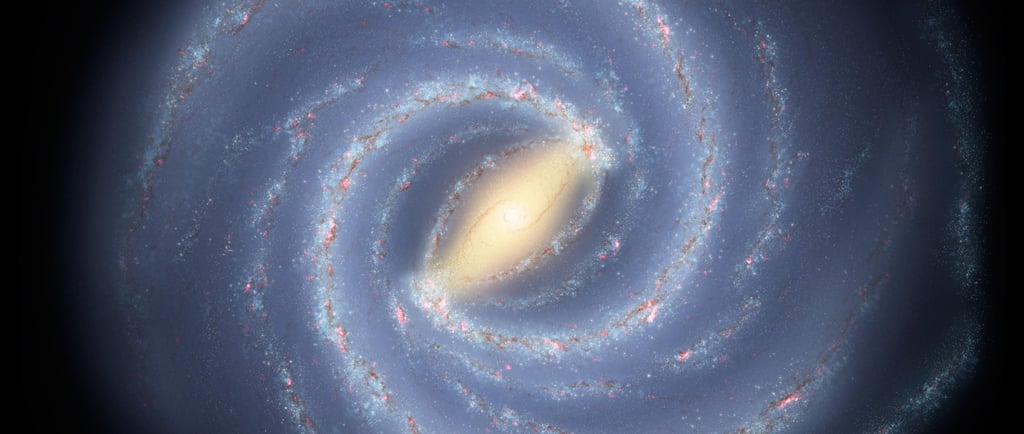
Our Galaxy (SMBH), the Milky Way, holding hundreds of billions of stars, spinning at a speed of 600,000 mph. Source: NASA/JPL-Caltech
PREMISE #1 — THE UNIVERSE IS NOT INFINITE
Our first premise is that the Universe is not infinite. We are contending the Universe had a beginning—that it began to exist. Why is it important to establish that the Universe actually had a beginning? Because Genesis 1 begins by saying, “In the beginning, God created the heavens and the earth.” The Judeo-Christian world view is based on the belief that before there was anything in the Universe, God already existed. He then created time, space, energy, and matter, what we call the Universe, or the heavens and the earth.
But why can’t matter and energy be infinite? Why can’t there be an infinite amount of energy and matter in our Universe (what is called “an infinite regress”) with no beginning and no end? This would be a problem for Judeo-Christian theists because Genesis says there was a beginning. But does this match what we know about the Universe? If the Universe (or multi-Universes) is infinite, then we don’t need God to create them.
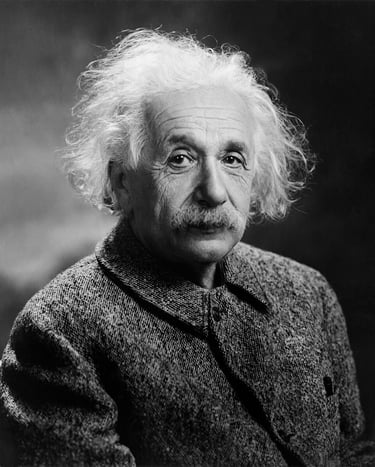

Some people believe that it is scientifically accurate to argue that matter and energy are infinite. Early on, Albert Einstein held this view and had difficulty with the idea that the Universe was finite and had a beginning. He was a Steady State theorist. Like Carl Sagan, Einstein believed “the Universe is all that is, or ever was, or ever will be.” If this is true, you don’t need God to explain the creation of the Universe.
When Albert Einstein began to realize there were indications that the Universe was expanding (pointing to a beginning), he fudged his data to say it wasn’t so.¹ English astronomer, physicist, and mathematician, Sir Arthur Eddington, discovered that Einstein’s figures were fudged and told him they were in error. Einstein admitted this to Eddington saying, “I know, I put those figures in on purpose because the data didn’t make sense.”²
What Einstein was discovering was that the Universe was expanding because it had a beginning. Eventually, he acquiesced as information came in from deep space that pointed to the Big Bang theory of cosmology—that the Universe began with a big bang. This aligns with the Genesis account of a beginning and is consistent with Christian theistic belief that an infinite, all powerful, eternal God spoke it into existence—a big bang.
FIRST REASON WHY THE UNIVERSE IS NOT INFINITE — BIG BANG COSMOLOGY
Understandably, those holding an atheistic world view assume, and would like to prove, that the Universe is infinite. We don’t need a God to explain the Universe’s creation, if it has always existed. However, if the Universe is not infinite, but had a beginning when time, space, energy, and matter came into existence then this aligns with the Judeo-Christian belief in what the Bible calls “the beginning.”
Skeptics think that people who believe in God do so out of ‘blind faith.’ It is like jumping off a cliff and thinking you will go up instead of down. They think that someone told us to believe this stuff, waved a Bible in front of us, and we just followed along. Skeptics believe they are independent thinkers who base their beliefs on truth derived from empirical data, while the person who believes in God is just following myths and fairy tales. The reverse is actually true.
Big Bang Cosmology, the currently accepted scientific model, says that the Universe began at a point of singularity. There was a beginning event, a point in which all matter and energy of the Universe was condensed into a single point, or what is called a point of singularity (even though that point of singularity may not have been physical or held physical properties). There is an unbelievable amount of scientific data and information coming in from deep space confirming Big Bang Cosmology.
The “Big Bang” says there was a beginning event when the time and space continuum, and all matter that we know, came into existence. This contradicts the Steady State Theory, which was the predominate theory held around the time of Einstein. However, science discovered subsequently that the Universe is not in a “steady state.” It is expanding and had a beginning.
To get around the idea that the Universe had a beginning, some have proposed the theory of an Oscillating Universe. The Oscillating Universe Theory is an eternally repeating Big Bang, wherein (like a Yoyo going up and down, and up and down forever) the Universe expands, collapses, and expands over, and over, and over again. It suggests that the Universe has been expanding and collapsing for all eternity.
The problem with the Oscillating Universe Theory is that our Universe has already reached what is called “escape velocity,” so that as it expands, it does not have enough mass to pull back down on itself. What’s more, if the Oscillating Universe theory was true, every time it did expand and collapse, it would lose energy. Something losing energy could not be sustained forever unless there is new energy coming into the system. This is the first Law of Thermodynamics, telling us we have no new energy coming into this system.
Another theory that seeks to get around the idea that the Universe had a beginning is the Multiple Universe Theory. The hypothetical idea of multiple Universes gets us nowhere. We have no evidence that multiverses exist. Everything we can observe, suggests there is just one Universe—our own.
Then there is the String Theory³explanation of everything. The String Theory states that everything in our Universe is made up of tiny vibrating strings, and that every functional particle that we know of is made up of these strings. For this theory to work, the String Theory implies that our Universe must have additional hidden dimensions, and that these extra dimensions are curled up into a compact space that is too tiny for us to observe or detect.
The problem “hidden dimensions,” too tiny for us to observe or detect (similar to undetectable parallel Universes, another theory of the existence of everything) is that if they are undetectable, do they actually exist in some kind of real time and real physical space? If so, how did they come into existence? If you say this Universe or other Universes have always existed, you run into a major problem because things that have always existed don’t have physical properties (to be explained in the next chapter). Neither the String Theory nor the Multiple Universe Theory have any supporting empirical data. They are not subject to experimentation, observation, or falsification, but are approximations or conjectures.
BIG BANG COSMOLOGY AND COSMIC MICRWAVE BACKGROUND RADIATION
Some people think the Big Bang is just one theory among many. It is not! All these other theories have been falsified scientifically. When you compare the theories above with the Big Bang Cosmology, which we’ve had years and years of data pouring in and confirming, the evidence is overwhelming.
One of the things pointing to the Big Bang is “cosmic background radiation.” Cosmic background radiation is one of the greatest discoveries of all time. In May 1964, Bell Lab astronomers, Arno Penzius and Robert Wilson⁴ were conducting experiments using a Holmdel Horn Antenna to detect radio waves and gain cosmological data from the Universe.
Everywhere Penzius and Wilson pointed the antenna they got some kind of static interference. They thought at first that it was the result of bird droppings, so they scraped the area everywhere around the antenna, yet they kept getting the same buzzing noise that they determined was coming from outside of our galaxy.
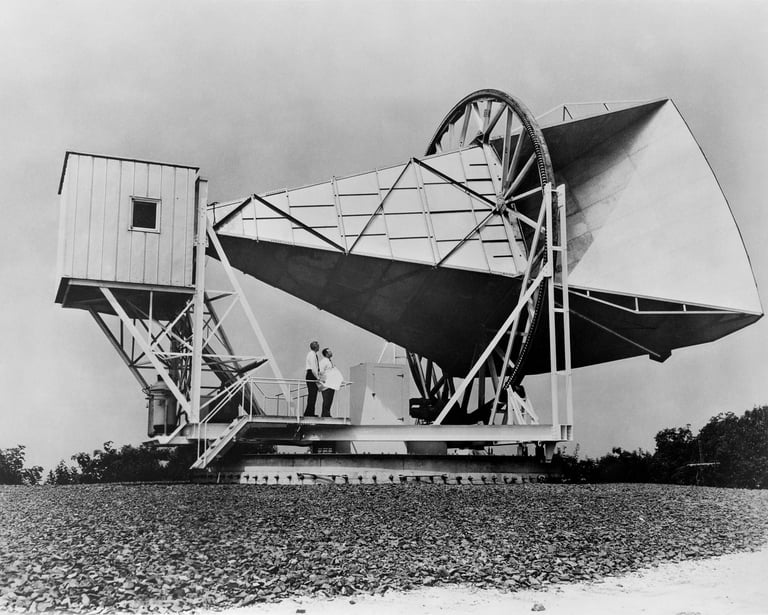
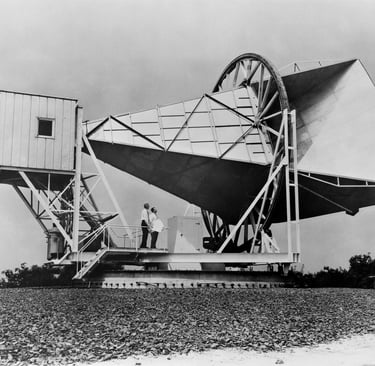
Penzius and Wilson suddenly realized they had stumbled across perhaps the greatest discovery of all time: microwave radiation background. Any direction they pointed the antenna, they received the same evidence of this microwave radiation background. It was the residue noise from the big bang explosion.
At this same time, scientists at Princeton University, including astrophysicist Robert H. Dicke, the Albert-Einstein-Professor of Science at Princeton University, had been working to detect residual radiation that they predicted would have resulted from the Big Bang origin of the Universe. When Dicke and his fellow scientists learned of the discovery of Penzius and Wilson, they realized that this was the greatest evidence ever discovered for the beginning of the Universe, and the confirmation of the Big Bang Cosmology. (In 1978, Penzias and Wilson were awarded the Nobel Prize in Physics.)⁵
When we say the Universe had a beginning, because of the work of Penzius and Wilson, we know it is scientifically verifiable. It’s not like the other theories above that have either been disproved or are unverifiable. These other theories are hypothetical conjectures. In contrast, Big Bang Cosmology, based upon credible science, points to the fact that the Universe had a beginning.
As already noted, Skeptics think that Christian Theists believe in myths and are at odds with science. But the reverse is true. Skeptics of theism are the ones who move more into myth, as their world views are based upon hypothetical theories that are neither verifiable nor falsifiable. The belief that the Universe had a beginning, that it is not infinite and has not always existed, is based upon scientific data and the scientific method. We are contending that science demonstrates that the Universe, time, and space, as we know it, had a beginning. The Universe began to exist. It came into existence. There is very little wiggle room around this.
CONCLUDING THOUGHTS
Why are we emphasizing that the Universe is not infinite (other than that science points to this)? Because if the Universe is infinite, then who needs God? The Bible says God created the Universe. If Genesis is true, then there was a beginning. In contrast, if the Universe is infinite, there wasn’t a beginning, and if there was no beginning, then we are in serious trouble as Christian theists.
If the Universe can be shown to have a beginning, then the Genesis account and belief in a God who created the Universe is credible. When someone wants us to show him or her that God exists, begin by pointing to the Big Bang Cosmology. The Universe doesn’t explain itself. It hasn’t always existed. It came from something. It began to exist. In the next chapter we will present two more reasons why the Universe has not always existed and is finite.
The 15 meter Holmdel horn antenna at Bell Telephone Laboratories in Holmdel, New Jersey was built in 1959 for pioneering work in communication satellites for the NASA ECHO I.
[1] “Essay; A Famous Einstein ‘Fudge’ Returns to Haunt Cosmology”
[2] Sir Arthur Stanley Eddington, OM, FRS did his greatest work in astrophysics. He was also a philosopher of science and a popularizer of science.
[3] “String Theory Explained in Simple Words,” Posted on August 6, 2018 by astrogeekz.
[4] The accidental discovery of cosmic microwave background radiation is a major development in modern physical cosmology. Although predicted by earlier theories, it was first found accidentally by Penzias and Wilson Their discovery was evidence for an expanding Universe, (Big Bang Theory and was evidence against the Steady State model. For more see, “What is the cosmic microwave background? By Elizabeth Howell , Daisy Dobrijevic published January 28, 2022.
[5] “Bell Labs researchers discover cosmic background radiation”
Next up: The Universe is Finite